Tuesday, 10 November 2015

Wednesday's "but why"? - the benefit of Pilates over other types of exercise

There is a lot of research out there promoting the "ideal" type of exercise for health, well being and fat-loss. Current trends promote things like high intensity interval training, walking, cross fit, yoga and strength training as the most valuable investment of your time.

I believe you know best what activities work best for you to improve your health, manage your weight and leave you feeling good about yourself. Our modern world is full of distractions, stresses and chaos. Each one of us is looking for a personal state of peace and tranquillity to help us make sense of everything that is going on in our lives. When searching for inner balance we might first think of popular self improvement techniques like meditation, simplifying, affirmations, etc, but we rarely consider exercise as a viable tool to help us balance our lives


It depends what your goals are, but have you thought about what Pilates might offer for your mental and emotional well-being? This post is all about "why" we might choose Pilates over or before other types of activities.


Pilates, like other mind-body regimes integrates conscious control of the physical self. If you are doing Pilates correctly, you cannot be planning what you're making for dinner or something that happened last weekend. You are required to focus, be present "in the moment" and execute a physical movement with control, breath and inner core control.


Pilates can uplift the mind and soul through

  • Increasing your sense of mastery, which can help if you don't feel in control of your life or mood 
  • Releasing muscle tension through stretching and mobilising 
  • Boosting feel-good endorphins. 
  • Helping you sleep better at night having expended energy 
  • Providing a distraction from your worries. 
  • Getting rid of built-up stress and frustration. 
  • Improving your health and body, which can help lift your mood 
Research has also found that Pilates might event make you smarter. A group of researchers from the University of Illinois at Urbana-Champaign reported in the Journal of Physical Activity & Health that people have significantly superior brain function after a mindful movement practice like Pilates or Yoga compared to aerobic exercise.

Pilates could even help you train your nervous system. Every time we move we use several specific areas of our brain, sending impulses through the spinal cord to muscle fibres.

When you learn to voluntary engage certain muscles (like deep core activation in Pilates) you fire a movement chain that might have been asleep for a long time. A healthy nervous system means better communication between your brain and other parts of your body as well as the release of stress-fighting and mood-boosting hormones.

Pilates is great for relieving stress tension in the body. In a stressful situation our body is ready to move at its peak performance, but in most modern-day scenarios we can’t run away when stuck in a traffic jam and can’t pick a fight with our boss.

Pilates relieves tension built up in the muscles through gentle stretching and gradual conditioning. Fascial release techniques that many Pilates instructors use today will help you loosen tight muscles that are not responsive to passive stretching. When you get stress out of your body, you also get it out of your mind.


A body free from nervous tension and fatigue is the ideal shelter provided by nature for housing a well balanced mind, fully capable of successfully meeting all the complex problems of modern living. - Joseph Pilates

Pilates helps you control your emotions. As you learn to control your breath you can feel empowered to use that conscious breathing into stressful times in your daily life.

If you enjoy Pilates you are improving your happiness which has a massive carry-over to other aspects of your life. Joseph Pilates believed that "physical fitness is the first requisite of happiness".


Through Pilates you may also become more confident, as you learn new skills while working with the unique limitations of your own body. You will learn to accept you may not have the longest hamstrings,allowing you to stretch your legs further than your peers, but you might find yourself appreciating your shoulder stability as you plough through a plank sequence. Posture has also been linked to confidence levels and you can give yourself a quick self-esteem boost just by sitting up straight.

I hope these thoughts have encouraged you to consider Pilates a valuable use of your time, investing in yourself and your well-being. I hope this also motivates you in class to give each movement your 100% effort, knowing you are reaping the benefits through body, mind and soul.


Until next time,


-Natasha


Tuesday, 3 November 2015

Wednesday's "But why?" post - Pilates thread the needle

Twisting and rotating is one of the most common movements that can put your neck or back out. Our modern sedentary lifestyle doesn't require a large range of rotation as it once did. When we find ourselves having to twist a little further than normal it can lead to uncomfortable muscle strains.

The Pilates thread the needle exercise, performed in the all fours position, is a wonderful rotational stretch that I like to include in almost every Pilates session. Most people find it quite challenging as they consider their mobility restricted through a tight chest and immobile neck. With correct execution, including focus on breath, this exercise can do wonders to release tension and enhance range of movement. 

There are lots of ways to "cheat" through this exercise, so pay attention to your form. Here are some tips:

  • Balance your bodyweight equally over your hands and knees throughout the exercise. 
  • Engage your core and keep your hips over your knees. 
  • Follow your hand with your gaze and truly turn your head to complete a full twist of the spine.
  • Try not to hold your breath at any point and make sure you exhale fully.

Here is my version of Pilates "thread the needle"

Prepare: Start in all fours position (hands and knees). If you have sensitive wrists you can use a fist position or slightly elevate the palms (I like to use the edge of the mat, slightly rolled up). Make sure you align your hands directly under your shoulders and your knees under your hips. Ensure your pelvis is neutral (natural curve through the lower back) and maintain a slight engagement of your pelvic floor/inner corset.
Inhale as you reach one arm up to the ceiling (or beyond). Spiral the whole torso, but drill your knees into the floor to keep your pelvis from shifting over one knee.


Exhale as you "thread" the same arm between the opposite arm and knee.


Come right down to the floor, resting the back of the shoulder on the ground and reaching the arm through as far as possible. Rotate your head to look past your shoulder to the ceiling. The supporting arm is bent and the palm is pressing into the floor to add additional rotation.


Inhale as you reach the same arm back up towards the ceiling.

Exhale as you return to your all fours starting position. Don't use this as a rest, consider it an opportunity to reset your excellent posture: stable shoulders, neutral pelvic, lengthened neck and engaged deep corset muscles.
Repeat with the other arm.

Do at least three full sets, trying to increase your range of movement with each set.


Tuesday, 27 October 2015

"But why?" on a Wednesday - The Spine Stretch

The Pilates spine stretch is possibly one of the most misunderstood exercises I've come across. At first glance it looks like a standard forward bend. Most people will feel this in their hamstrings, and when the hamstrings are tight the exercise can become rigid and ineffective.

The element that makes the Pilates Spine Stretch an effective mobilisation exercise for the spine is the use of breath, focus and flow. It is not simply about bending forward and seeing how far you can go, it is about the journey and the observations along the way. The controlled exhalation gives time to find where you have opportunity to extend your range of movement. The inhalation enhances space between the ribs and further decompresses the vertebrae.

When setting up for this exercise in the seated position, you can bend your knees enough to allow for a fully neutral pelvis. You may even need to sit on a cushion or rolled towel to life the buttocks off the floor. 

Make sure you perform this exercise slowly enough to concentrate on keeping your shoulders relaxed and find length along the vertebrae as you move into flexion and back to neutral.

I find the most important element of this exercise is to approach it totally relaxed. Other exercises require a little more dynamic energy, where as this is about letting go while keeping a steady connection with the inner corset.

Pilates Spine Stretch

1) Prepare seated with your legs straight in front of you and your arms reaching forward at shoulder height.

2) Inhale to prepare. Feel your whole spine lengthen towards the ceiling as you send your breath into the deeper half of the lungs. Use your abdominal corset to feel as though you're lengthening your torso.


3) As you exhale, start from the neck and slowly release the spine into a rounded position over the legs. Ensure the weight of the head leads the movement and you keep your belly button pulled into your spine.

4) Stay in the rounded stretch forward as you inhale. Push the inhaled breath up into the back of the lower ribcage to intensify the stretch across the back.

5) As you exhale maintain your abdominal connection and slowly begin rolling up to your starting postiion. Start the roll from the lower spine and return the head to neutral last.

6) Repeat all 5-10 times.

If you want suffer from tight hamstrings but want to work towards an amazing spine stretch, I highly recommend this video.


Tuesday, 20 October 2015

Wednesday's "why do we do..." rolling like a ball

I haven't done "rolling like a ball" with my clients in a while, but it really is one of my favourites.

It always manages to produce a few giggles as it brings you back to a natural movement of childhood.

This exercise is brilliant for spinal flexion and engages good core strength to hold the tucked position. You have to be really aware of the curve of your spine and also how to find your balance point. You can really enhance the energy of the exercise through dynamic, full breaths that feel like they're pulling your whole body into the movement. 


How to "roll like a ball"

Start seated, with your spine long and your knees bent. 
Gently rest your hands on the tops of your shins. 

As you exhale, release your spine into a c-curve, tucking your tailbone between your legs. Balance on the back of your pelvis as you float your feet off the floor.

Inhale as you rock back quickly, until just before the bottom of your shoulder blades touch the floor. Don't go back too far! As you perform the rock back your whole body should stay in the tucked position, including your head. Don't lead the rock back by extending the neck.

Exhale to rock back up to your starting balance point. Use your abdominal muscles to control your movement.

Repeat ten times.


There are several options for different arm and leg positions. The main focus point is the rounded, flexed spine and the engagement of your breath and deep corset muscles.


Tuesday, 13 October 2015

"But why?" Wednesdays - the Dart


I've yet to meet a client who hasn't complained of tight shoulders and neck muscles , which is usually caused by poor posture. Many people suffer more than others, but the majority of people can benefit from a simple postural strengthening exercise called "the Dart".

This simple exercise, when practiced for just a few minutes a day can relieve shoulder, neck and lower back tension. This exercise will strengthen upper back muscles to improve posture and improve shoulder placement. The Dart exercise also helps to increase mobility in the thoracic spine and engage core stability through extension of the spine.

The Dart can be challenging to grasp at first. If you are already tight across your chest and front of shoulders as well as weak across your upper back, it will seem as though you are restricted from moving. As you practice, your improved thoracic extension strength will help you get more out of the exercise as well as improve your posture throughout your daily activities. This improved posture takes the load off the neck and shoulders and allows your head to sit on top of your spine and out of the forward carrying head position.

The dart should be performed with the deep abdominal muscles correctly supporting the lower back. If your legs are lifting off the floor when you are in the Dart position,  your lower back muscles are likely "taking over" most of the load in extension. But scooping our belly button towards your spine and focusing on length, rather than lift, you can allow the upper back muscles to engage. This sometimes feels a little unnatural, considering our thoracic spine has a normal flexion (forward bend) curve. With practice, and as the chest and front of the shoulders open up, you will begin to find move movement and strength in the upper spine without over extending the lower back.

If you would like to radically improve your posture in just a few minutes a day, try practicing this exercise for ten repetitions daily. Try really opening up the front of the shoulders as you come into extension and to keep your corset/pelvic floor engagedRemember to breath deeply, inhaling for at least three seconds (count to three), and exhaling for the same or longer. A good breathing pattern is:
  • Inhale to prepare.
  • Exhale as you extend through the spine allowing the forehead off the floor (just a few centimetres)
  • Inhale and hold the position. This is a good opportunity to ensure your pelvic floor and corset are engaged. You an also try to open up the shoulders a little more.
  • Exhale and release back down to the floor.
There are lots of variations we can do with this exercise, and many progressions into challenging exercises that use more of the muscles through the back, legs and shoulders. However on its own, I would rank the Dart is an excellent "top ten" Pilates exercise recommended for almost anyone.


Tuesday, 6 October 2015

"But why?" Wednesdays - Hundreds

Pilates Hundreds

Why do we do them?
Is there a functional purpose other than an amazing ab "burn"?

Hundreds are one of the signature Pilates exercises. Everyone who has ever done Pilates has done some varation of Hundreds. If you google Pilates the images often show people doing Hundreds exercises, including Joseph Pilates himself.

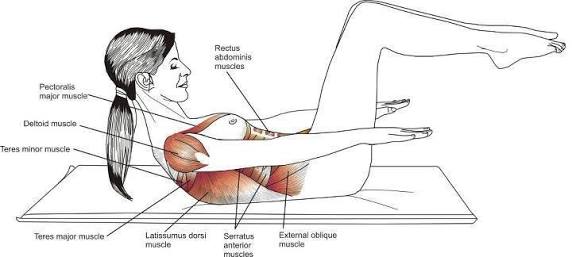
Hundreds are popular because, when done correctly, they are an amazing abdominal toning exercise. The surface abdominal muscles are working hard to pull the body, against gravity, into flexion. The dynamic breathing and pulsing arm movements add a challenge to these core muscles. I've also seen Hundreds done very badly with poor neck alignment, rounded shoulders and a loaded lower back pulled out of neutral alignment.

The functional purpose behind the Hundreds exercise is core strength. If the deep corset muscles are active throughout the exercise thanks to fluid breath and deep concentration, a maximum core strength effect can be obtained. Maintaining good head placement, avoiding straining the neck and keeping a wide collarbone can also strengthen deep neck flexors and the postural muscles of the back. 

Multiple variations on head placement, leg placement and breathing can ease strain or enhance intensity. You can also add an unstable surface or small props.

If you stay true to the Pilates principles and concetrate on your alignment and good corset activation the Hundreds are a powerhouse Pilates exercise full of benefits.

What is your favourite variation? Have you tried a dose of daily Hundreds?

Until next time...

-Natasha

Wednesday, 11 May 2011

Pilates and Pregnancy - Important Exercises

Pilates is commonly prescribed as a great exercise for pregnancy - the reasons for this include:
  • low impact
  • low intensity
  • good core focus
  • postural awareness
  • mind body awareness and connection
  • mobility and flexibility
  • pelvic floor conditioning
  • focus on breathing
Pregnancy is very individual, so it important that pregnant participants seek out qualified relevant advice before embarking on a Pilates programme during their pregnancy.   At a minimum, you should check with your doctor or medical practitioner prior to attempting any Pilates exercises.  However, as a general guide, the following exercises are of great benefit during your pregnancy:

CLAMS:
Clams are an important glute and deep external rotator strengthener.  It is important to keep these mucles toned during pregnancy to provide support to the pelvis and the sacro illiac joints, which often become looser as a result of higher levels of the hormone "relaxin" during pregnancy.
ABDOMINAL CENTREING:
Abdominal centreing is one of the basic principles of Pilates.  During pregnancy, you should avoid lying on your back after your first trimester.  The all fours position is a wonderful release for the lower back during pregnancy, and an excellent position to practice abdminal centreing.
PELVIC FLOOR EXERCISES:
I cannot emphasize enough the importance of exercising your pelvic floor muscles - remember this is the "two for one" muscle work out, as your transverse abdominus muscles are also contracted when you engage your pelvic floor.  Important both pre and post natal.
SINGLE SIDE LEG LIFT
Again, an important exercise for strengthening the supportive muscles to the pelvis.


For a more individualised program, be sure to consult with your Pilates practitioner.

Until next time,
Natasha Debsieh
Practical Pilates